Product Presentation, Product Reviews
How to inspect an engine with an automotive borescope?
For automotive technicians and enthusiasts, engine health checks are crucial for maintaining vehicle performance and extending service life. With technological advancements, automotive borescope have become indispensable tools.
I. Why Inspect the Engine?
Since the engine is the heart of a vehicle, any minor issue can quickly escalate into a major failure if left undetected.
The purpose of engine inspection includes:
• 🔧 Detecting carbon deposits and sludge: Long-term operation may cause buildup on cylinders, pistons, and intake/exhaust valves
• 🔧 Assessing mechanical wear: Evaluating cylinder wall, piston ring, and valve seat wear
• 🔧 Early fault detection: Cylinder block cracks, seal failures, coolant passage blockages, etc.
• 🔧 Extended engine lifespan: Timely maintenance reduces major repair risks
Traditional methods like engine disassembly are not only time-consuming but also costly. Endoscopes enable rapid issue identification without disassembly.
II. What are the differences between automotive borescope and visual inspection?
In addition, visual inspection of engines often struggles with the following limitations:
• Obstructed visibility (difficult to observe in confined spaces)
• Insufficient lighting (dark engine interiors)
• Difficulty identifying details (hard-to-spot micro-cracks and carbon deposits)
Moreover, endoscopes deliver several distinct advantages:
• 📸 Access tight spaces: Easily reach cylinders, combustion chambers, exhaust pipes, etc.
• 💡 LED illumination: Brightens engine interiors
• 🖥 Real-time display: Details clearly visible on screens or mobile devices
• 📹 Photo/video capture: Facilitates documentation and sharing of inspection findings
Moreover, endoscopes improve safety, increase efficiency, and provide precise evidence to support diagnosis, compared to visual inspection.
III. How to Select an Endoscope Suitable for Engine Inspection?
When choosing an engine automotive borescope, consider the following aspects:
- Probe Diameter
◦ For smaller cylinders and intake ports, recommend a small-diameter probe of Φ5-8mm - Probe Length
◦ Inspection of deep engine areas requires a probe length of ≥1 meter - Light Source Brightness
◦ High-brightness LED lights with adjustable intensity ensure clear visibility inside. - Display Method
◦ Connect to a smartphone/tablet or use a standalone screen for convenient operation and documentation. - High-Temperature Resistance & Waterproofing
◦ Engine environments are hot; probes must withstand high temperatures, resist oil contamination, and be waterproof - Photo/Video Recording Capability
◦Additionally, it enables technicians to save inspection records and facilitates more intuitive communication with clients.
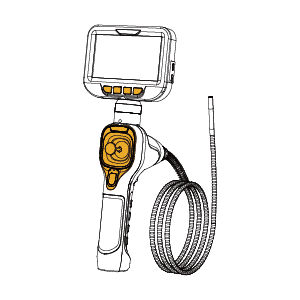
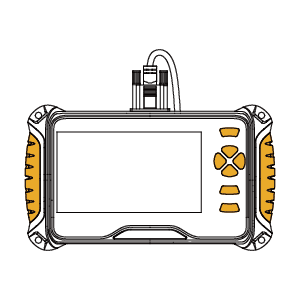
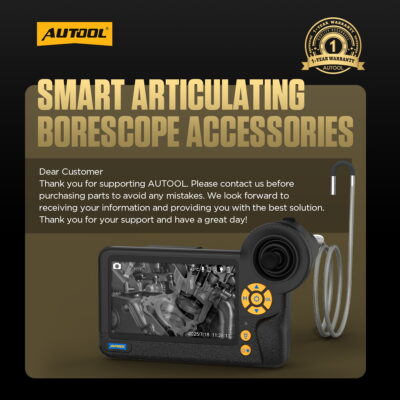
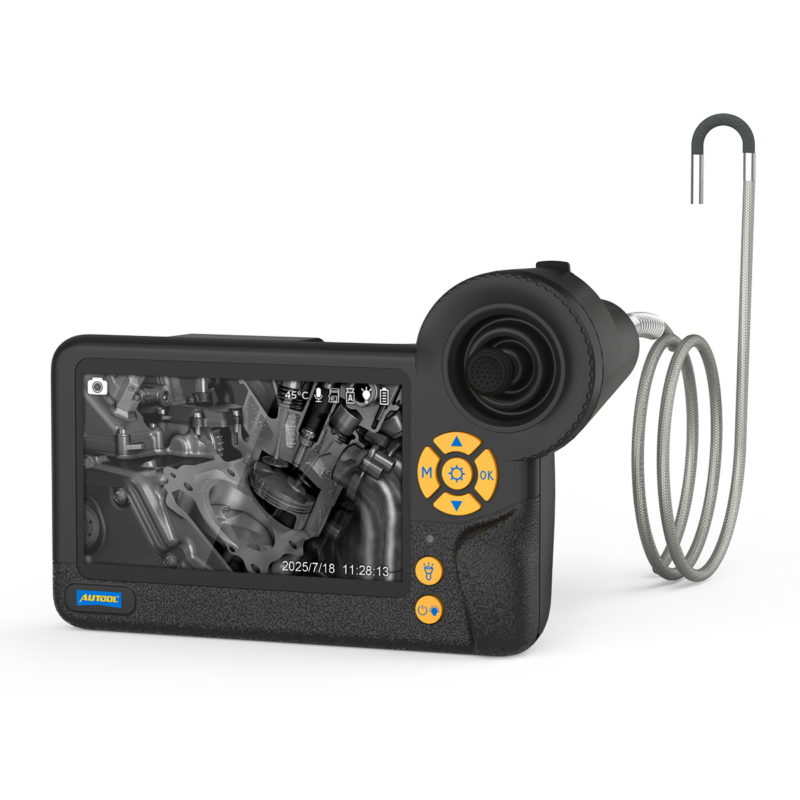
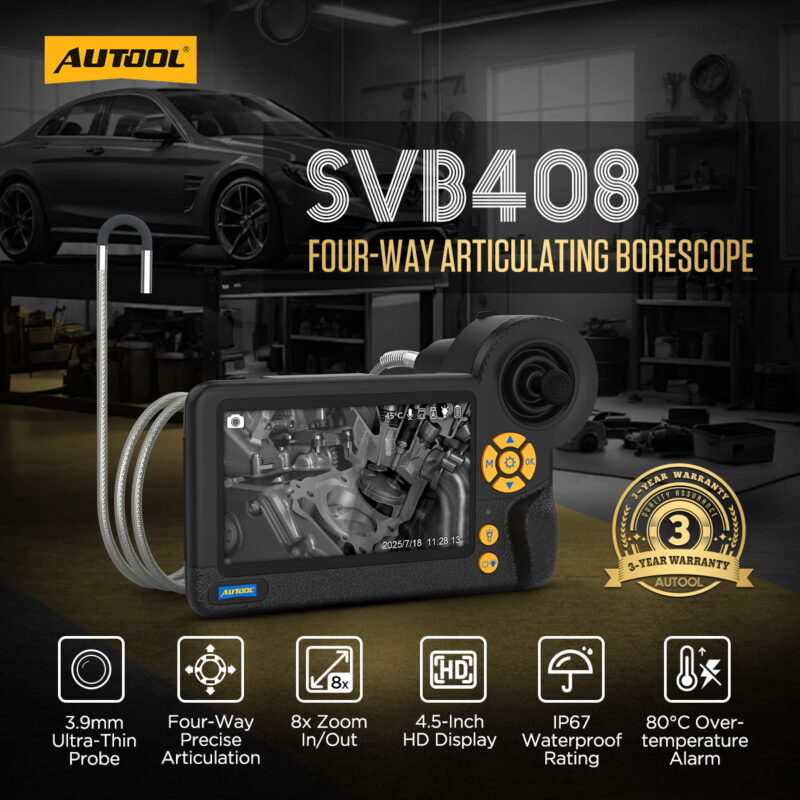
IV. Product Recommendation: AUTOOL SVB408
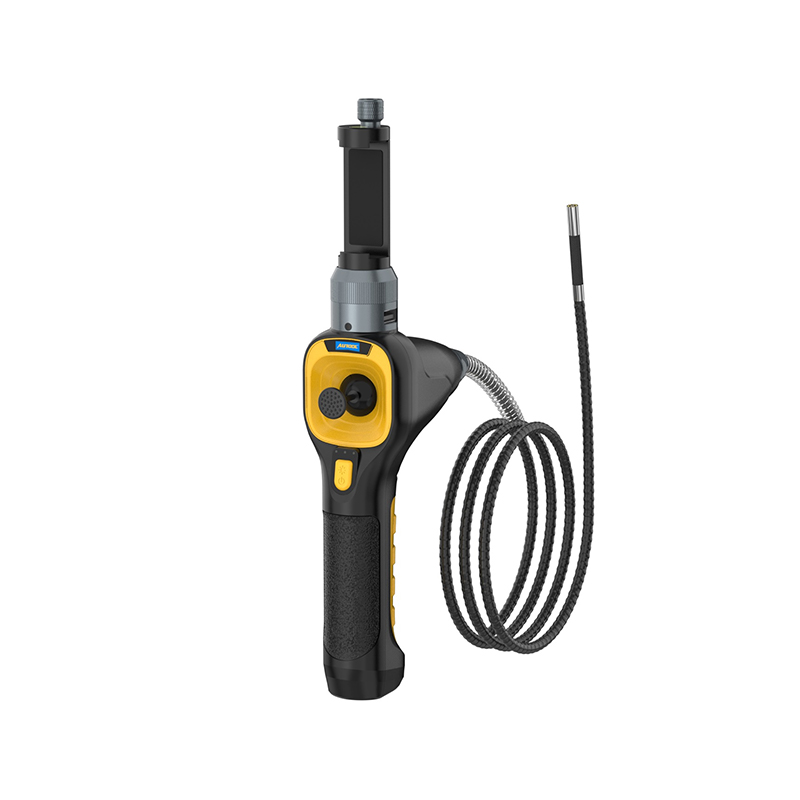
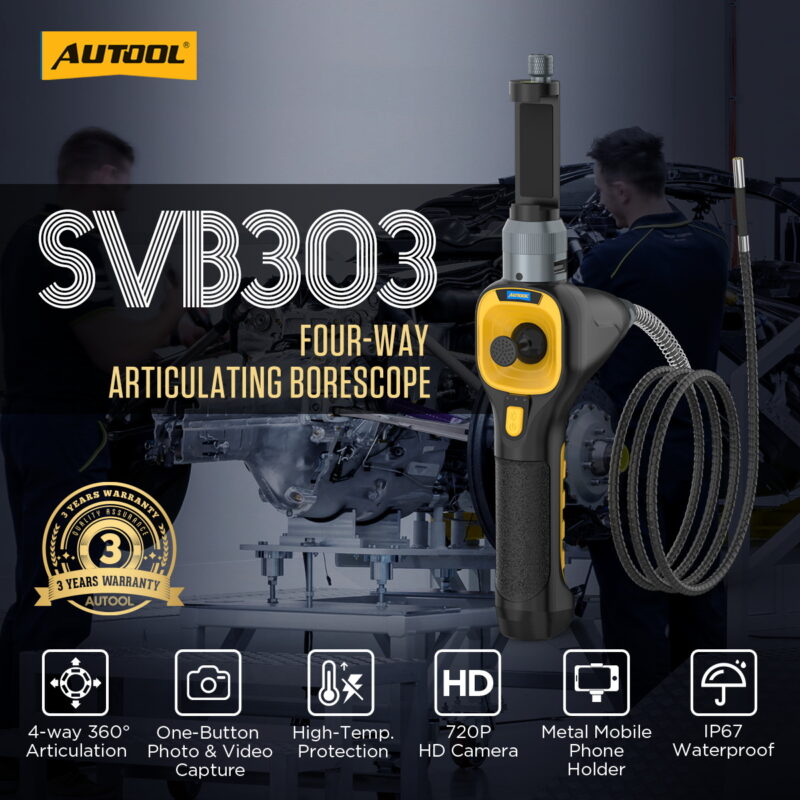
If you’re seeking a professional, durable, and user-friendly engine endoscope, the AUTOOL SVB408 is the ideal choice.
🔧 Core Advantages
• HD Camera: 1080P high-definition imaging for clear visibility of engine internals.
• Ultra-Compact Camera: Just 3.9mm diameter for effortless access to tight spaces
• Heat & Water Resistance: Withstands engine oil, moisture, and steam environments.
• Furthermore, the extended probe design lets you reach deep into cylinder blocks and exhaust pipes with ease.
• Additionally, the live display and recording feature lets you use an independent screen or connect to a smartphone for inspection documentation.
Ideal for: Auto repair shops, automotive enthusiasts, and DIY vehicle inspections.
V. Summary
Furthermore, engine inspection is a critical step in ensuring vehicle performance, and visual checks alone often fail to reveal subtle issues.
Using the AUTOOL SVB408:
• Enhances engine inspection efficiency
• Identifies potential problems for proactive prevention
• Safe, convenient, and easy to operate
• Record and share inspection results
In modern automotive repair and routine maintenance, endoscopes are no longer luxury tools but essential equipment.
If you seek fast, professional engine internal inspections, the AUTOOL SVB408 endoscope is absolutely worth owning.
HOT
New
-36%
HOT
Original price was: $319.00.$205.00Current price is: $205.00.
 Home
Home Shopping Guide
 Product
 Wheel Aligner Machine
 Smoke Leak Detector
 Fuel Injector Tester
 Brake Fluid Exchanger
 Dry lce Blasting Machine
 Walnut Sand De-Carbon Cleaner
 Refrigerant Recovery Machine
 Articulating Borescope
 Transmission Fluid Exchanger
 Spark Plug Tester
 Battery System Tester
 Engine Pressure Tester
 Diagnostic Multimeter
 Key Frequency Tester
 Maintenance Environment Tester
 Pneumatic Oil Drainer & Extractor
 Oil Analysis Tester
 Circuit Tester
 OBD Diagnostic Tool
 Digital Manifold Gauge
 Inverter Programming Power Supply
 EV Charging
 Used Car Diagnostic Tester
 Cooling System Tester and Filler
 Workshop Tool Storage Series
 EV Battery Pack Air Tightness Tester
 Wheel Alignment Machines
 ACCESSORIES&OTHER
 News
News Help Center
 Custom Solutions (OEM & ODM)
 Track My Order
 Online Support