



AUTOOL Blog, News & Events
Types of Car Lifts: The Complete Guide to Car Lift Types
In the auto repair industry, one essential piece of equipment stands out—the car lift. It plays a key role in daily repair work. Whether for oil changes, tire service, or complex underbody repairs and wheel alignments, car lifts raise vehicles to a safe working height. This creates a stable and efficient workspace for technicians.
In this article, we break down the main types of car lifts, their applications, and their core functions. This will help you quickly understand why car lifts are a must-have in any professional repair shop.
What are the different types of car lifts?
As vehicle ownership grows and repair needs expand, the car lift market continues to evolve. It now offers a wide range of products. Based on structure and function, car lifts fall into several main types. Each type has its own design advantages.
2 post car lift: The cost-effective choice for small workshops
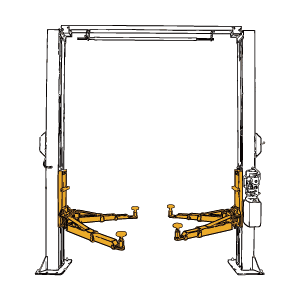
The 2 post car lift (including gantry lifts) ranks among the most commonly used types. Its core structure features two vertical columns and retractable lifting arms, and hydraulic cylinders inside the columns drive these arms to achieve lifting and lowering motions. Above all, its greatest advantage lies in its compact footprint—it does not require excessive workshop space, thus demonstrating strong adaptability to various installation sites. Additionally, it comes with a relatively affordable price tag, making it the preferred option for many general repair shops and neighborhood quick-service garages. However, it is crucial to note that it imposes strict requirements on the installation foundation; a solid and stable foundation is a prerequisite to ensure its safe and stable operation.
4 post car lift: The stability specialist for heavy-duty vehicles and precision operations
As the name implies, the 4 post car lift adopts four vertical columns as its core load-bearing structure, paired with top crossbeams and a hydraulic drive system. Its load-bearing capacity far exceeds that of 2 post car lifts—standard models can typically support 3 to 5 tons, while heavy-duty variants can even handle loads exceeding 10 tons. Thanks to this robust structural design, it is not only ideal for repairing large SUVs, trucks, and minibuses but also serves as the perfect companion for four-wheel alignment tasks. Its precise horizontal level control ensures the accuracy of alignment data. Furthermore, we equip some models with a secondary lifting function—a feature that further enhances operational convenience for technicians.
Automotive scissor lift: The flexible all-rounder for space optimization and quick-service operations
The automotive scissor lift utilizes a distinctive scissor-type mechanical structure. You can classify it into in-ground (recessed) and surface-mounted types according to installation methods, with a further breakdown into large-scissor and low rise scissor car lifts. First and foremost, its core advantage is its compact structure. The ultra-thin low-rise scissor car lift has a minimum height of about 220 mm. Vehicles can drive onto it easily. It takes up little space, so workshops can place it near the reception area for pre-inspections or in quick-service bays to improve efficiency. In addition, large scissor lifts work well with four-wheel aligners. They offer a maximum lifting height of up to 2.1 meters. They provide ample operating space underneath the vehicle, striking an excellent balance between flexibility and practicality.
Single-post and multi-post lifts: The specialized equipment for niche scenarios
Single-post lifts are designed for partial lifting purposes, available in both mobile and fixed models. They can precisely lift one side of a vehicle, making them perfect for tire changes and local undercarriage inspections. They offer great operational flexibility without taking up much space. In contrast, multi-post lifts are the “giants” engineered for large rail transit vehicles such as trains and light rail trains. By virtue of the coordinated load-bearing capacity of multiple columns, they can support the enormous weight and size of such large vehicles, fulfilling the requirements of specialized repair scenarios.
Applicable scenarios for different types of lifts
The core principle for selecting a car lift is “matching to specific needs”. By choosing the right type based on repair services, vehicle models, and workshop conditions, you can maximize operational efficiency. Below are tailored recommendations for different scenarios:
Quick-service maintenance bays (oil changes, pre-inspections, minor maintenance): Prioritize low rise scissor car lifts. They are easy to operate and feature fast lifting speeds. Vehicles can complete pre-inspections and basic maintenance without needing to drive deep into the workshop, which helps reduce congestion in the workshop and improves reception efficiency. In fact, the maintenance efficiency of one low rise scissor car lift can even match that of 1.5 units of 2 post car lifts.
Four-wheel alignment bays: Opt for large-scissor lifts or 4 post car lifts. Both can guarantee high-level accuracy and lifting stability. You can equip large-scissor lifts with auxiliary devices such as turntables and side slip plates, while you can use 4 post car lifts for alignment work on heavy-duty vehicles—these setups ensure precise and reliable measurement data.
Engine/undercarriage overhaul bays: 2 post car lifts or large-scissor lifts are more appropriate choices. 2 post car lifts offer high cost-effectiveness and flexible operation, meeting the overhaul needs of small vehicles such as sedans and SUVs. Meanwhile, large-scissor lifts provide ample operating space, allowing repair technicians to use various tools with ease and adapting well to complex overhaul tasks.
Heavy-duty vehicle repair (trucks, minibuses, light trucks): Choose 4 post car lifts or heavy-duty large-scissor lifts without hesitation. These models have strong load-bearing capacity, enabling technicians to work under the vehicle with peace of mind and eliminating potential safety hazards.
Small workshops with limited space: Give priority to in-ground scissor lifts or 2 post car lifts. In-ground scissor lifts can be hidden beneath the floor, without affecting workshop traffic flow. On the other hand, 2 post car lifts have a small footprint and can fulfill diverse repair needs within limited space.
The core functions of car lifts in repair workshops
Car lifts earn the title of the “right-hand man” in repair workshops because they are essential equipment. More importantly, they reshape repair operations in three key areas: safety, efficiency, and user experience. Their core functions are reflected in the following three aspects:
1、Ensure operational safety and reduce safety risks
On the other hand, you can pair large scissor lifts with four-wheel aligners. These lifts offer a maximum lifting height of 2.1 meters. In traditional repairs, technicians often work under vehicles with limited visibility and higher slip risks. In contrast, car lifts use safety devices such as limit switches, overload protection, and explosion-proof valves to improve safety. These devices stably fix vehicles at specified heights, eliminating accidental descent risks and safeguarding technicians. In particular, 4 post car lifts automatically cut power and hydraulic circuits at maximum height, further boosting safety performance.
2、Improve operational efficiency and reduce labor intensity
After vertically lifting the vehicle, car lifts not only provide technicians with a spacious operating space but also eliminate the need for strenuous postures such as bending over and lying prone, thus significantly reducing labor intensity. Take oil changes as an example: with the help of car lifts, technicians no longer need to dig underground pits. They lift the vehicle within minutes and provide fast access to the oil pan. This improves work efficiency by over 50%. You can also match different car lift types to specific repair tasks. This supports specialized equipment and positions, improving overall workshop efficiency.
3、Optimize space utilization and expand business scope
WhatsApp: +86 18926477404
Email: shop@autooltech.com
 Home
Home Shopping Guide
 Product
 Wheel Aligner Machine
 Smoke Leak Detector
 Fuel Injector Tester
 Brake Fluid Exchanger
 Dry lce Blasting Machine
 Walnut Sand De-Carbon Cleaner
 Refrigerant Recovery Machine
 Articulating Borescope
 Transmission Fluid Exchanger
 Spark Plug Tester
 Battery System Tester
 Engine Pressure Tester
 Diagnostic Multimeter
 Key Frequency Tester
 Maintenance Environment Tester
 Pneumatic Oil Drainer & Extractor
 Oil Analysis Tester
 Circuit Tester
 OBD Diagnostic Tool
 Digital Manifold Gauge
 Inverter Programming Power Supply
 EV Charging
 Used Car Diagnostic Tester
 Cooling System Tester and Filler
 Workshop Tool Storage Series
 EV Battery Pack Air Tightness Tester
 Wheel Alignment Machines
 ACCESSORIES&OTHER
 News
News Help Center
 Custom Solutions (OEM & ODM)
 Track My Order
 Online Support